
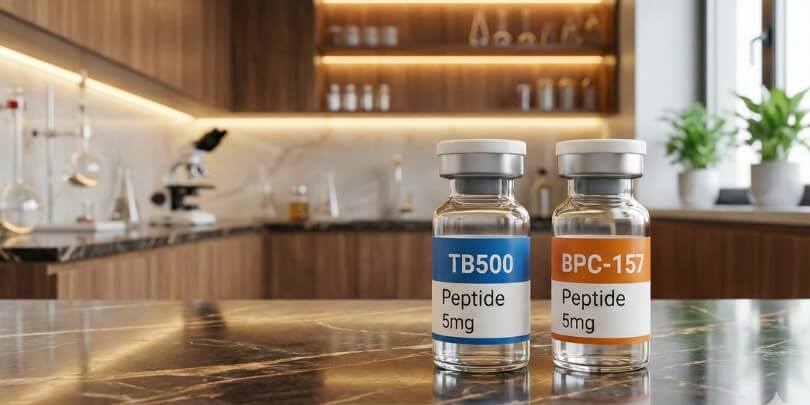
TB-500 and BPC-157 are both peptides that get grouped under “regenerative” or “recovery” marketing, but they’re not the same compound, they’re not used for the same evidence-backed indications, and they don’t have the same level (or type) of research behind them.
Most importantly for a conservative, evidence-informed site: neither TB-500 nor BPC-157 is FDA-approved for human therapeutic use, and much of the enthusiasm you’ll see online goes well beyond the current quality of human clinical data.
Key Points
TB-500 is commonly described as a synthetic thymosin beta-4–related fragment/derivative, tied to an actin-binding domain (often discussed as Ac-LKKTETQ).
BPC-157 is a 15–amino-acid peptide studied mainly in animal and lab models for tissue injury and repair signaling, with limited human evidence.
In practical terms, the biggest difference is the evidence base: thymosin beta-4 (related to TB-500) has some human clinical research in topical/wound and ocular contexts, while BPC-157 human evidence remains very limited and is discussed primarily through preclinical data and recent reviews.
What TB-500 Is
In most real-world usage, “TB-500” is marketed as a thymosin beta-4 (Tβ4)–related peptide. Tβ4 is a naturally occurring 43–amino-acid peptide involved in cell migration, inflammation signaling, and tissue repair processes, and its actin-binding domain has been studied for its role in cell movement and wound-healing biology.
Where this gets confusing is that TB-500 is often discussed as a fragment/derivative rather than full-length thymosin beta-4. Anti-doping and analytical work has identified TB-500 content as an acetylated thymosin beta-4 fragment (Ac-LKKTETQ).
Bottom line: when people say “TB-500,” they are often borrowing from the broader thymosin beta-4 research story–even though TB-500 itself does not have the same depth of human clinical study across common “recovery” claims.
What BPC-157 Is
BPC-157 is a 15–amino-acid peptide that’s widely promoted for tendon/ligament recovery, joint pain, and gut support. The literature base is largely preclinical, with animal models reporting effects on healing-related signaling (growth factors, inflammation pathways, angiogenesis-related processes) and tissue injury outcomes.
Recent sports-medicine focused reviews summarize the research as “promising but limited,” emphasizing that most studies are not high-level human clinical trials and that real-world safety/quality concerns exist when products are sourced outside regulated drug pathways.
The Practical Difference In How Clinics Talk About Them
In clinics and online communities, TB-500 is more commonly framed around soft-tissue recovery and mobility/flexibility, while BPC-157 is more commonly framed around tendon/ligament complaints, joint irritation, and gut-related symptoms.
Those “use cases” are largely driven by marketing patterns and preclinical rationale–not by strong, consistent human trial data for the typical injection-based “sports recovery” applications people expect.
For a conservative site, it’s safest to present both as investigational peptides, and to emphasize that results (if any) should be tracked in function (training consistency, flare frequency, mobility, sleep quality) rather than hype.
Safety
Because neither TB-500 nor BPC-157 is FDA-approved for human therapeutic use, safety concerns aren’t just about side effects–they’re also about product quality, contamination risk, dosing inconsistency, and unrealistic claims.
It’s also relevant for athletes: WADA’s Prohibited List explicitly references thymosin-β4 and derivatives (e.g., TB-500) and also lists BPC-157 under unapproved substances.
A conservative approach avoids self-sourcing, avoids “research use only” products, and treats any discussion of these peptides as a risk/benefit decision that should be individualized and monitored.
Sources & Citations
The evidence for TB-500 vs BPC-157 is best represented by (1) research on thymosin beta-4 biology and clinical studies in topical/ocular and wound contexts, (2) analytical work clarifying what TB-500 contains, and (3) recent reviews summarizing BPC-157’s largely preclinical evidence base.
- The Actin Binding Site Of Thymosin Beta 4 Mapped By Chemical Synthesis (PMC)
- Thymosin Beta 4 Ophthalmic Solution For Dry Eye (Human Trial, PMC)
- Progress On The Function And Application Of Thymosin β4 (Review, PMC)
- Investigation Of TB-500 Metabolism And Identification As Ac-LKKTETQ (WADA Research Page)
- Emerging Use Of BPC-157 In Orthopaedic Sports Medicine (Systematic Review, PMC)
- Regeneration Or Risk? A Narrative Review Of BPC-157 For Musculoskeletal Healing (PMC)
Next Steps
If you’re deciding between TB-500 and BPC-157 (or wondering whether either is appropriate), the safest next step is a consult focused on your actual goal (pain relief vs function vs tissue recovery), what options exist with stronger human evidence, and what you will track to measure real progress.
Ready to talk it through? Book a discovery call with our team.
"This content is for educational purposes and does not substitute personalized medical advice."
Quentin Caswell, MSN, is an Integrative and Functional Medicine Specialist dedicated to helping patients feel their best. Board certified in advanced bioidentical hormone replacement and peptide therapy, he earned his Master of Science in Nursing from the University of Missouri (Mizzou) and opened Advanced Practice Wellness Clinic in 2011.