
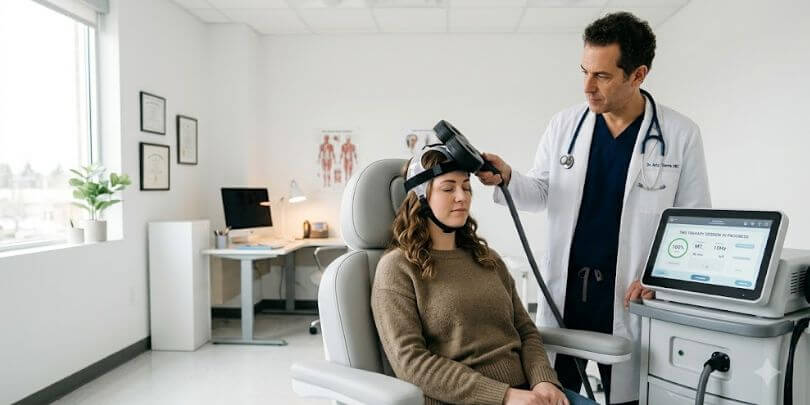
TMS, or transcranial magnetic stimulation, uses focused magnetic pulses to stimulate nerve cells in targeted areas of the brain. For depression, TMS most often targets the dorsolateral prefrontal cortex, a region involved in mood regulation, attention, motivation, and communication with deeper emotion-processing circuits. The magnetic pulses create small electrical currents in brain tissue, which can change how active certain brain networks are over time. TMS does not “shock” the brain, erase memories, require anesthesia, or cause a seizure as part of treatment. Instead, it is a noninvasive form of neuromodulation designed to help underactive or dysregulated mood circuits communicate more effectively.
Key Points
- TMS uses magnetic pulses, not electricity through the scalp. A coil is placed against the head and creates a magnetic field that passes through the skull. This magnetic field induces small electrical currents in the targeted brain area.
- It targets brain circuits involved in mood regulation. For depression, treatment commonly stimulates the left dorsolateral prefrontal cortex, which is connected to deeper brain regions involved in mood, motivation, reward, and emotional regulation.
- TMS changes brain activity over time. Repeated sessions may help shift cortical excitability, network communication, and neuroplasticity. Neuroplasticity means the brain’s ability to adapt, strengthen, or reorganize connections.
- It is not the same as ECT. TMS does not require anesthesia, does not intentionally cause a seizure, and does not involve the same memory-related side effect profile as electroconvulsive therapy.
- It is noninvasive. TMS does not require surgery, implanted electrodes, or medication entering the bloodstream. Most patients are awake during treatment and can usually return to normal activities afterward.
- Different protocols can have different effects. Frequency, intensity, pulse pattern, coil type, session length, treatment location, and number of sessions all affect how TMS influences the brain.
- Results are gradual for many people. Some patients notice changes within a few weeks, while others improve later in the treatment course. TMS is usually delivered as a series of sessions rather than a one-time treatment.
Understanding What TMS Does
Transcranial magnetic stimulation is a type of noninvasive brain stimulation. During treatment, a magnetic coil is placed near the scalp. The coil produces brief magnetic pulses that pass through the skull and influence electrical activity in nearby brain tissue.
The brain communicates through electrical and chemical signaling. TMS does not add a drug to the body. Instead, it uses electromagnetic stimulation to influence the firing patterns and excitability of neurons in a targeted region.
For depression, the most common target is the dorsolateral prefrontal cortex, often shortened to DLPFC. This area helps regulate mood, attention, executive function, motivation, and communication with deeper emotional circuits. Research has long connected this region and related brain networks with depression symptoms.
When TMS is repeated over multiple sessions, it may help shift how these networks function. The goal is not to “force happiness” or change personality. The goal is to help mood-regulating circuits become less stuck in patterns associated with depression, low motivation, rumination, and poor emotional regulation.
The exact mechanism is still being studied. Current evidence suggests TMS affects cortical excitability, brain network connectivity, neurotransmitter systems, and neuroplasticity rather than working through one single pathway.
How Magnetic Pulses Affect Brain Cells
The TMS coil creates a rapidly changing magnetic field. That magnetic field passes through the skull and induces a small electrical current in the brain tissue underneath the coil. This is the same basic physics principle that allows a changing magnetic field to create electrical activity.
Neurons communicate through electrical signals. When TMS stimulates a targeted region, it can increase or decrease the likelihood that neurons will fire, depending on the protocol used. Repetitive TMS, or rTMS, delivers pulses in a repeated pattern to create longer-lasting changes in brain activity.
High-frequency stimulation is often used to increase activity in a targeted area, while low-frequency stimulation is often used to reduce activity. Other protocols, such as theta burst stimulation, use patterned bursts that may produce similar effects in shorter sessions.
For depression, many protocols aim to increase activity in the left prefrontal region or rebalance activity across mood-related networks. Some approaches target the right prefrontal cortex, bilateral areas, or use deeper coils depending on the condition and device.
The stimulation is targeted, but the effect is not only local. Because the prefrontal cortex communicates with deeper brain regions, changing activity in one area may influence broader networks involved in mood, reward, fear, attention, and emotional regulation.
How TMS May Help Depression
Depression is not simply a chemical imbalance. It involves brain circuits, stress biology, sleep, inflammation, hormones, genetics, environment, trauma, medications, and life context. TMS focuses on the brain-circuit part of that picture.
In many depression protocols, TMS stimulates the left dorsolateral prefrontal cortex. This region is often involved in executive control, emotional regulation, and top-down communication with deeper mood centers. Some research suggests this area may be underactive or poorly connected in some people with depression.
Repeated stimulation may help improve communication between the prefrontal cortex and deeper networks involved in emotion, reward, motivation, and negative thought patterns. This may reduce symptoms such as low mood, low motivation, loss of interest, rumination, and emotional heaviness in some patients.
TMS is often used when depression has not responded well enough to medication, therapy, or other standard treatments. It may also be considered when medication side effects are a major problem, though candidacy depends on the diagnosis, severity, safety history, and insurance requirements.
TMS does not work for everyone, and response varies. It is best understood as a treatment that can help regulate brain networks in selected patients, not as a guaranteed cure or a replacement for all other mental health care.
How TMS Is Different From ECT And Medication
TMS is different from electroconvulsive therapy, or ECT. ECT uses controlled electrical stimulation under anesthesia to intentionally produce a therapeutic seizure. TMS does not require anesthesia and does not intentionally cause a seizure as part of treatment.
ECT can be highly effective for severe depression, catatonia, psychotic depression, or urgent situations, but it has a different side effect profile and treatment setting. TMS is typically done in an outpatient office while the patient is awake.
TMS is also different from medication. Antidepressant medications circulate throughout the body and affect neurotransmitter systems broadly. TMS acts more directly on targeted brain circuits and does not usually cause systemic medication side effects such as weight gain, sexual side effects, nausea, or sedation.
That does not mean TMS has no side effects. Common side effects can include scalp discomfort, tapping sensations, headache, facial muscle twitching during treatment, or temporary lightheadedness. Serious side effects, such as seizure, are rare when appropriate screening and safety protocols are used.
Many patients continue therapy, medication, lifestyle support, sleep care, or other treatments during TMS. The best plan depends on the person’s diagnosis, symptom severity, medication response, risk profile, and goals.
What Happens During A TMS Treatment Course
A TMS treatment course usually begins with a consultation and safety screening. The provider reviews diagnosis, medications, seizure history, implanted devices, metal in or near the head, medical history, substance use, sleep, bipolar symptoms, and prior treatment response.
During the first session, the treatment team maps the target area and determines the motor threshold. Motor threshold is the amount of stimulation needed to produce a small movement in a hand or finger muscle. This helps personalize the treatment intensity.
During treatment, the patient sits in a chair while the coil rests against the scalp. The machine delivers pulses that may feel like tapping or knocking on the head. The patient remains awake and can usually leave the office shortly afterward.
TMS is usually given as a series of sessions, often five days per week for several weeks, although protocols vary. Some newer protocols use shorter sessions, theta burst stimulation, or accelerated schedules in selected settings.
Improvement may be gradual. Some people notice better sleep, less heaviness, more motivation, or improved emotional flexibility before their mood fully changes. Others do not notice improvement until later, and some do not respond enough to continue.
Who It’s For And Who Should Be Cautious
TMS may be appropriate for adults with major depressive disorder who have not improved enough with standard treatment or who have difficulty tolerating medication. It is also used in certain protocols for other conditions, such as obsessive-compulsive disorder, depending on the device, diagnosis, and clinical setting.
People who should be screened carefully include those with a history of seizures, epilepsy, brain injury, brain tumors, stroke, implanted medical devices, metal in or near the head, cochlear implants, deep brain stimulators, vagus nerve stimulators, or unstable medical conditions.
People with bipolar disorder need careful evaluation because mood activation or mania is possible, although uncommon. A provider should ask about past manic or hypomanic symptoms before starting treatment.
People with severe substance use, unstable medications, active suicidal crisis, psychosis, severe insomnia, or complex neurologic conditions may need a more specialized treatment plan. TMS may still be considered in some cases, but safety and urgency matter.
The right candidate is not simply someone who wants a non-medication option. The right candidate is someone whose diagnosis, treatment history, safety screening, and goals fit the therapy.
Risks, Side Effects, and Monitoring
TMS is generally considered noninvasive and well tolerated, but side effects can happen. Common side effects include scalp discomfort, headache, tapping discomfort, facial twitching during treatment, neck discomfort, fatigue, or temporary lightheadedness.
Seizure is the rare but most serious known risk. Risk is reduced by proper screening, correct dosing, trained staff, and avoiding unsafe stimulation settings. People with seizure history, certain neurologic conditions, or medications that lower seizure threshold need careful review.
Hearing protection may be used because the device can make loud clicking sounds. Patients should tell the treatment team if they experience ear discomfort, worsening headaches, neurologic symptoms, or unusual changes during treatment.
Mood should be monitored throughout treatment. Some people may feel emotionally more activated, anxious, irritable, or sleep-disrupted during the course. Patients with bipolar-spectrum history require extra monitoring for hypomania or mania.
Monitoring should include symptom scales, sleep, anxiety, mood, motivation, side effects, medication changes, substance use, suicidality, and functional improvement. TMS should be part of a broader mental health plan, not left on autopilot.
Safety
Seek urgent help right away for suicidal thoughts with intent or plan, new psychosis, severe agitation, mania, seizure, fainting, sudden neurologic symptoms, severe confusion, chest pain, or any rapidly worsening mental health crisis. These symptoms need immediate medical or emergency mental health care.
Call your provider for non-urgent but important concerns such as worsening headaches, scalp pain that does not improve, sleep disruption, increased anxiety, irritability, mood elevation, impulsivity, medication changes, substance use changes, or symptoms that worsen during treatment.
If you have implanted devices, metal in or near the head, seizure history, bipolar disorder, neurologic disease, pregnancy, recent medication changes, or complex medical conditions, TMS should be coordinated with a qualified clinician. Safe TMS care depends on proper screening, accurate targeting, trained staff, and ongoing monitoring.
Sources and Citations
- Transcranial Magnetic Stimulation — Mayo Clinic
- Repetitive Transcranial Magnetic Stimulation — NCBI Bookshelf
- Mechanisms of Action of TMS in the Treatment of Depression — PubMed
- Use of Transcranial Magnetic Stimulation for Depression — PMC
- Transcranial Magnetic Stimulation of Left Dorsolateral Prefrontal Cortex — PMC
- Transcranial Magnetic Stimulation: A Review of Its Evolution and Current Applications — PMC
"This content is for educational purposes and does not substitute personalized medical advice."
Quentin Caswell, MSN, is an Integrative and Functional Medicine Specialist dedicated to helping patients feel their best. Board certified in advanced bioidentical hormone replacement and peptide therapy, he earned his Master of Science in Nursing from the University of Missouri (Mizzou) and opened Advanced Practice Wellness Clinic in 2011.